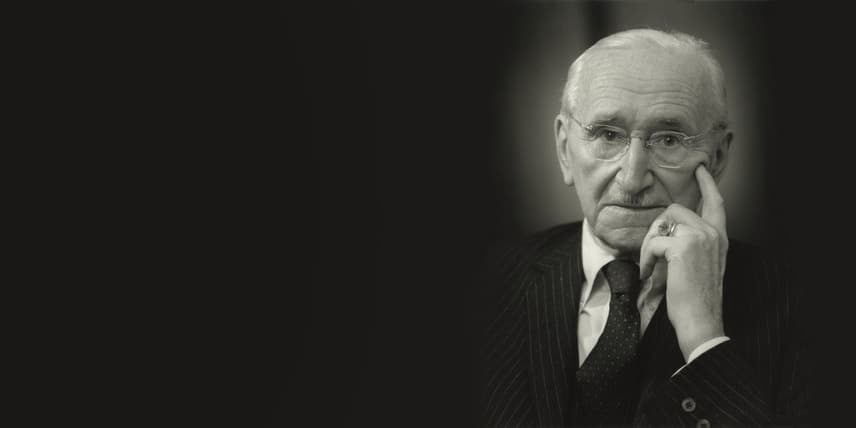
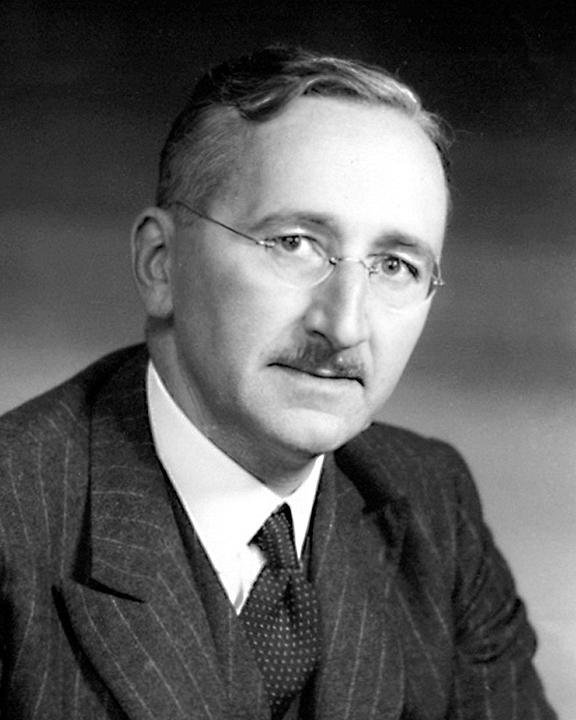
FOLIO I · DENKER
Friedrich August von Hayek in audio: the life, the one idea, the most famous argument, and which work to read first. About 15 minutes.
New episodes appear continually. The newsletter will let you know when the next one is out.
Matura at the Viennese Elisabethgymnasium.
Joined an artillery regiment in 1917 and fought on the Italian front; suffered hearing damage to his left ear.
After the war he enrolled in law at the University of Vienna, but devoted himself mainly to economics, psychology, the philosophy of science and philosophy. He read Carl Menger and Eugen von Böhm-Bawerk, made his first contacts with the Austrian School and came to know members of the Vienna Circle.
Received a doctorate in law (Dr. iur.) at the University of Vienna in 1921 under Friedrich von Wieser.[6]
Reading Ludwig von Mises's "Die Gemeinwirtschaft" (Socialism; 1922), which demonstrated the impossibility of economic calculation in a socialist commonwealth, turned him away from his socialist sympathies.[1]
Received a doctorate in political science (Dr. rer. pol.) at the University of Vienna in 1923.[7]
In 1923/1924 he worked as a research assistant to Jeremiah Jenks at New York University, where he compiled macroeconomic data.[8]
In August 1926 he married Helene Berta Maria von Fritsch ("Hella").[9]
Together with Mises he founded the Austrian Institute for Business Cycle Research, where from 1927 Hayek did "hard pioneering work on the economic foundations". Mises had earlier recognized his talent and invited him to the private seminar.[1]
He completed his Habilitation in 1929 at the University of Vienna with "Monetary Theory and the Trade Cycle".[16]
Appointed in 1931 as Tooke Professor of Economic Science and Statistics at the London School of Economics; he lectured there on business cycle theory and shaped a generational dispute with Keynes.[1]
Took British citizenship in 1938 and declined to return to Nazi-annexed Austria.[18]
In 1941 he began the preparatory work on "The Road to Serfdom", an analysis of the forms of socialism in Germany and the Soviet Union as well as of democratic socialism as a creeping path to servitude.
Publication of "The Road to Serfdom" in 1944 in London; the book became a striking publishing success, sold more than 2.25 million copies and made Hayek world-famous.
In 1947, at Vevey on Lake Geneva, he gathered 39 non-collectivist thinkers from around the world, among them Wilhelm Röpke, Walter Eucken, Ludwig Erhard, Milton Friedman, Henry Hazlitt, Karl Popper, Fritz Machlup, Lionel Robbins and Ludwig von Mises, to found the Mont Pèlerin Society.
In July 1950 he divorced Hella and, in the same month, married his cousin Helene Bitterlich.[10]
From 1950 he taught for twelve years as a professor at the Committee on Social Thought of the University of Chicago.[1]
Publication of "The Constitution of Liberty" in 1960, a synthesis of his liberal constitutional and legal philosophy.[11]
Chair of economic policy at the Albert Ludwig University of Freiburg from 1962 to 1968.[12]
Honorary professor at the University of Salzburg from 1969 to 1977.[13]
Received on 9 October 1974 (awarded in December 1974 in Stockholm) the Alfred Nobel Memorial Prize in Economic Sciences, together with Gunnar Myrdal, for his pioneering work on monetary theory and on the institutional preconditions of economic order.[1]
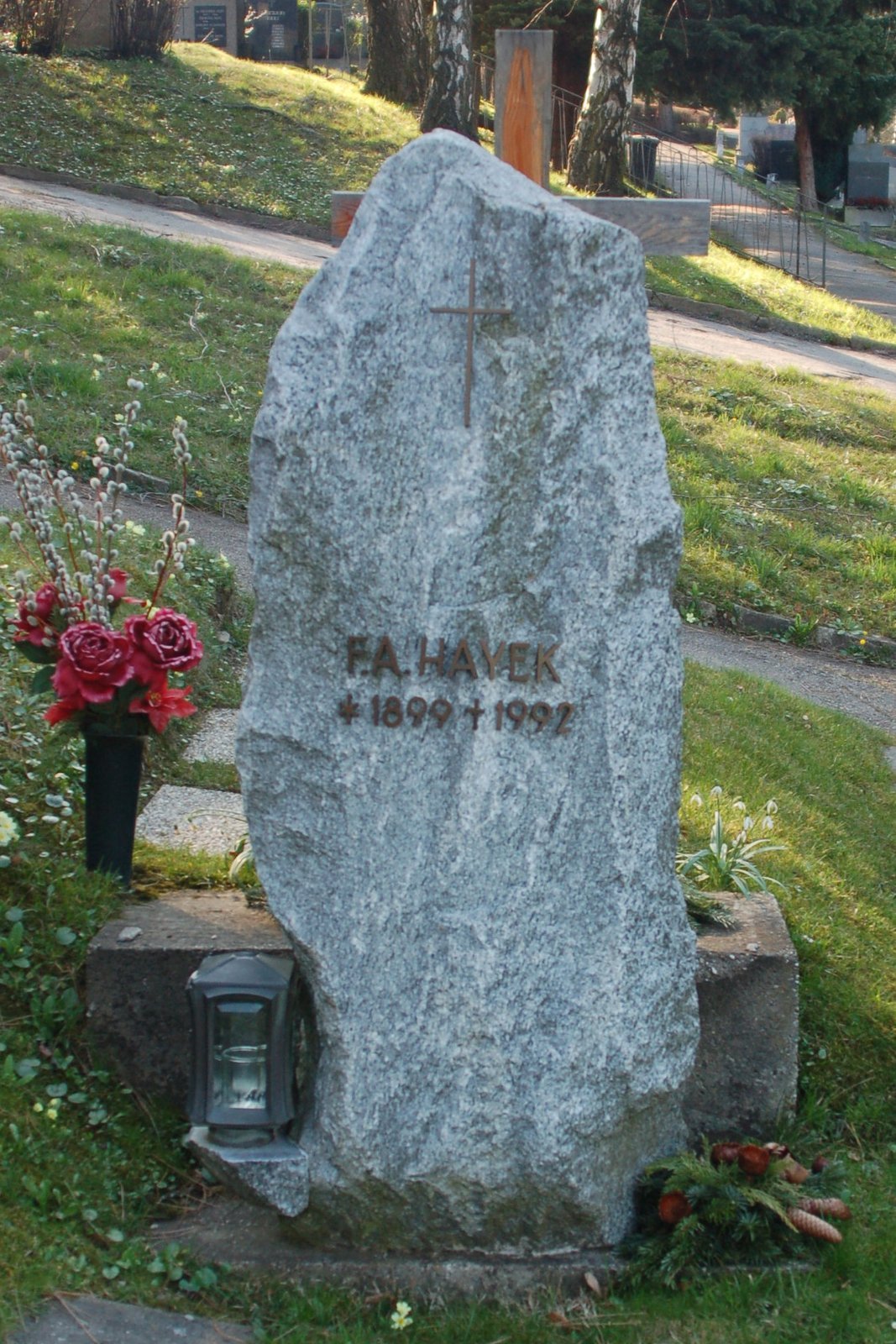
Returned in 1977 to Freiburg im Breisgau and remained there until his death in 1992.[13]
Admitted to the Order of the Companions of Honour in 1984 (Birthday Honours of Queen Elizabeth II).[19]
Received the Presidential Medal of Freedom in 1991 from US President George H. W. Bush.[20]
Died on 23 March 1992 in Freiburg im Breisgau.
Hayek received his doctorate in law (Dr. iur.) at the University of Vienna in 1921 under Friedrich von Wieser, whose most faithful disciple he became (“his most faithful disciple”).[16]
Reading Ludwig von Mises' Socialism (Die Gemeinwirtschaft, 1922), which contained the proof of the impossibility of economic calculation in a socialist commonwealth, turned him away from his socialist sympathies. Quite soon Mises recognised Hayek's talent and invited him to his private seminar.[1]
Gradually became the chief opponent of John Maynard Keynes (1883-1946) towards the end of the 1930s, yet increasingly fell into academic isolation.
mises.org-Strigl-Biographie nennt Hayek explizit als von Strigl geprägten Schüler: „Strigl shaped the minds of Hayek, Haberler, Machlup, Morgenstern, and other future great Viennese economists more than any other teacher." Hayek-Nachruf 1942: „with his death disappears the figure on whom one's hope for a preservation of the tradition of Vienna as a centre of economic teaching... had largely rested."[3]
Wittgenstein war ein Cousin Hayeks; in der Wikipedia-Infobox „Influences" als philosophischer Bezugspunkt geführt.[14]
A direct student of Friedrich August von Hayek; in 1935 she submitted her dissertation “The Rationale of Central Banking and the Free Banking Alternative”, supervised by Hayek, at the LSE.[5]
Lewis studied under Hayek at the LSE in the 1930s.[15]
Coase studied under Hayek at the London School of Economics as a student in the 1930s.[15]
At the LSE, Lachmann belonged to Hayek's closest academic circle and developed radical subjectivism further out of this line.
Through his writings and the edited anthology “Logik der Freiheit” he contributed substantially to reviving the tradition of the Austrian School, and Hayek's work in particular, in the German-speaking world.
After Shackle had begun his doctoral thesis under Hayek, he subsequently turned to radical subjectivism and pushed it as far as nihilism.
Fellow participant in the Mises-Privatseminar in Vienna.[22]
Together with Mises he founded the Austrian Institute for Business Cycle Research, where from 1927 Hayek did “hard pioneering work on the economic base”.
Haberler held his courses at the University of Vienna partly jointly with Friedrich August von Hayek.
Both participants in the Mises-Privatseminar; at the same time predecessor and successor at the head of the Konjunkturforschungsinstitut (Hayek until 1931, Morgenstern 1931-38).[4]
After his studies, a colleague of Friedrich August von Hayek at the London School of Economics; collaboration until the move to Johannesburg in 1948.
Frank Knight belonged to the founding meeting of the Mont Pèlerin Society in 1947 and took part in choosing its name.[23]
Versammelte 1947 bei Vevey am Genfer See 39 nicht-kollektivistische Denker aus aller Welt, unter ihnen Fritz Machlup, zur Gründung der Mont Pèlerin Society. Reihenfolge nach Geburtsjahr (Machlup 1902 vor Hayek 1899 — hier Hayek vor Machlup).
In 1947 at Vevey on Lake Geneva he gathered 39 non-collectivist thinkers from around the world, among them Ludwig von Mises, to found the Mont Pèlerin Society.[1]
George Stigler belonged to the founding meeting of the Mont Pèlerin Society in 1947.[23]
Gathered 39 non-collectivist thinkers from around the world at Vevey on Lake Geneva in 1947, among them Henry Hazlitt, to found the Mont Pèlerin Society.
Gathered 39 non-collectivist thinkers from around the world at Vevey on Lake Geneva in 1947, among them Karl Popper, to found the Mont Pèlerin Society.
Gathered 39 non-collectivist thinkers from around the world at Vevey on Lake Geneva in 1947, among them Lionel Robbins, to found the Mont Pèlerin Society.
Gathered 39 non-collectivist thinkers from around the world at Vevey on Lake Geneva in 1947, among them Ludwig Erhard, to found the Mont Pèlerin Society.
Gathered 39 non-collectivist thinkers from around the world at Vevey on Lake Geneva in 1947, among them Milton Friedman, to found the Mont Pèlerin Society.
Gathered 39 non-collectivist thinkers from around the world at Vevey on Lake Geneva in 1947, among them Walter Eucken, for the founding of the Mont Pèlerin Society.
Gathered 39 non-collectivist thinkers from around the world at Vevey on Lake Geneva in 1947, among them Wilhelm Röpke, for the founding of the Mont Pèlerin Society.
Became a member of the society in 1948, one year after Hayek founded the Mont Pèlerin Society, together with her husband Friedrich A. Lutz; Friedrich Lutz was later twice president of the MPS.[21]
Belonged to the Mont Pèlerin Society initiated by Hayek; joined in 1948.
Became a member of the Mont Pèlerin Society in 1996, among whose founders and central figures Hayek was numbered (Hayek himself died in 1992, hence only a temporally overlapping society membership, via the Hayek legacy).[24]
Beide Teilnehmer am Mises-Privatseminar in Wien (mises.org Hayek Centenary).[4]
Friedrich August von Hayek in the context of the School as a whole — five generations, their teacher-student lineages, circles and collegial ties.
Show in the family tree →