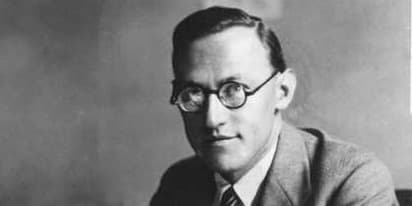
FOLIO I · DENKER

Studied political science in Vienna and, while still a student, became an assistant to Hans Mayer.
From 1923, assistant at the Chair of Political Economy under Hans Mayer at the University of Vienna.[7]
A three-year Rockefeller research fellowship trip to American and European universities.[1]
Completed his Habilitation in 1929 with “Wirtschaftsprognose: Eine Untersuchung ihrer Voraussetzungen und Möglichkeiten” (Economic Forecasting: An Investigation of Its Preconditions and Possibilities) in Vienna.[1]
He taught at the University of Vienna until 1938. A staff member and later the successor of Friedrich August von Hayek at the Austrian Institute for Business Cycle Research; editor of the Zeitschrift für Nationalökonomie, board member of the Nationalökonomische Gesellschaft (the Austrian Economic Association), adviser to the National Bank and the Ministry of Trade, and a participant in the Mises Private Seminar.
Editor of the “Zeitschrift für Nationalökonomie” from 1930 until his forced emigration in 1938.[1]
As Friedrich August von Hayek's successor, he directed the Austrian Institute for Business Cycle Research in Vienna from 1931 to 1938.[1]
In the course of the Anschluss to Hitler's Germany in 1938, he was dismissed as institute director and lost his teaching licence. He emigrated to the United States and settled at Princeton University.[1]
Professor at Princeton University from 1938 until his retirement in 1970; from 1944 also working in close collaboration with John von Neumann at the Institute for Advanced Study.[1]
Together with the mathematician John von Neumann, he published the ground-breaking "Theory of Games and Economic Behavior".[1]
Married Dorothy Young in 1944; acquired US citizenship the same year.[10]
In 1963, together with others, he initiated the founding of the Institute for Advanced Studies (IHS) in Vienna and took on a role on its academic advisory board.
After becoming emeritus at Princeton in 1970, he moved to New York University and taught there until his death in 1977.[1]
Received in 1976 the Grand Decoration of Honour in Gold for Services to the Republic of Austria.[1]
Already during his studies, became an assistant to Hans Mayer at the Chair of Political Economy of the University of Vienna and received his doctorate under him in 1925.[1]
Strigl pragte laut mises.org-Strigl-Biographie die Denker der vierten Wiener Generation — Hayek, Haberler, Machlup, Morgenstern — als Lehrer wie kaum ein anderer; seine systematische Expositionsweise war im Hörsaal prägend.[4]
Lionel W. McKenzie wird in der Wikipedia-EN-Infobox als Doktorand Morgensterns aufgeführt.[8]
Martin Shubik wird in der Wikipedia-EN-Infobox als Doktorand Morgensterns geführt; promovierte an der Princeton University in den 1950er-Jahren.[8]
Both participants in the Mises-Privatseminar; at the same time predecessor and successor at the head of the Konjunkturforschungsinstitut (Hayek until 1931, Morgenstern 1931-38).[5]
Beide Teilnehmer am Mises-Privatseminar; mises.org-Liste führt Machlup und Morgenstern als regelmäßige Teilnehmer.[5]
Haberler held his courses at the University of Vienna partly jointly with Oskar Morgenstern.[5]
Participant in the Mises-Privatseminar in Vienna as a member of the inner circle of the Austrian School.[5]
Co-editor of the “Zeitschrift für Nationalökonomie” with Oskar Morgenstern; joint dissemination of Austrian-economic ideas.[9]
Publizierte 1944 gemeinsam mit dem Mathematiker John von Neumann die bahnbrechende „Theory of Games and Economic Behaviour" — Geburtsstunde der Spieltheorie.[1]
Morgenstern was in lively correspondence with Kauder and encouraged his history-of-science work on the history of marginalism.[6]
Oskar Morgenstern in the context of the School as a whole — five generations, their teacher-student lineages, circles and collegial ties.
Show in the family tree →